


For its debut, BMW chose to show the five-door hatchback model, but the range will eventually grow to include a three-door hatchback followed by the coupe, cabriolet and if the grapevine holds true, a longer and more spacious Gran Turismo version in the likes of the 3-Series GT we recently showed you in these spy shots.
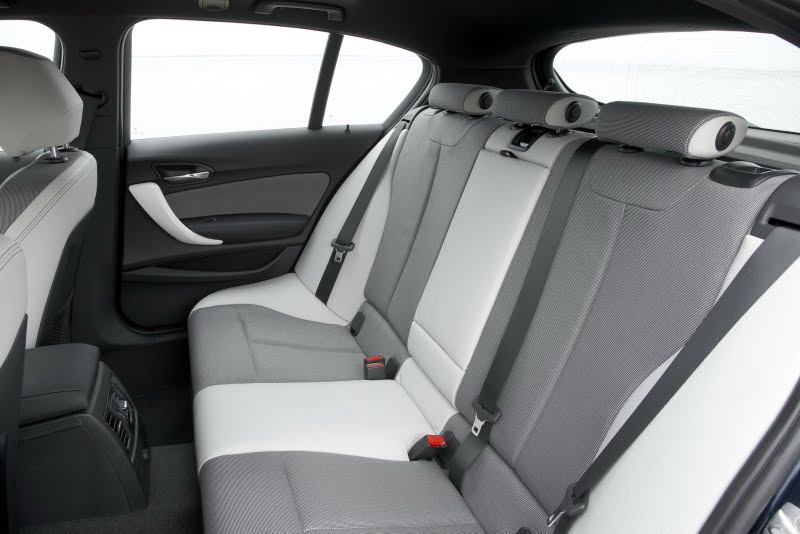
The second iteration of the 1-Series codenamed F20 is built on the same platform architecture as the upcoming F30 3-Serie. The five-door hatch is 85 mm (3.3-in.) longer than its predecessor, at 4,324 mm (170.2-in.), while the wheelbase has widened by 30 mm to 2,690 mm (105.9-in). Furthermore, its overall width has increased by 17 mm to 1,765 mm (69.5-in) due to an increase in track of 51 mm at the front and 72 mm at the rear, whereas its height remains unchanged at 1,421 mm (55.9-in.). BMW says the rear passengers have 21mm more legroom, and the luggage compartment has expanded by 30 liters to 360 liters (12.7 cubic feet).
Crafted under the watch of BMW’s Chief designer Adrian van Hooydonk, the styling of the new 1er is an evolution of the outgoing model with sharper and more prominent creases and a dramatic front-end design with abnormally large headlamps stretching all the way to the wheel arches.
It’s a similar story inside as the styling is more evolutionary than revolutionary. Aside from the larger center console with fresh switchgear and the new steering wheel design, BMW claims it boasts higher-grade materials and more attention to detail. As an option, the company offers its latest iDrive system that includes a retractable screen on top of the dashboard.
The big news lies under the hood as BMW finally introduced its long awaited, smaller displacement, turbocharged four-cylinder gasoline engine. The 1.6-liter unit with TwinPower Turbo and direct injection technology will be available at first in two states of tune delivering 136-horses and 220Nm (162.3 lb-ft) in the 116i and 170-horses and 250Nm (184.4 lb-ft) in the 118i.
For diesel fans, the junior rear-wheel drive BMW offers a redesigned 2.0-liter turbocharged four-cylinder delivering 116HP in the 116d, 143HP in the 118d and 184HP in the 120d. BMW said it will also launch a 116d EfficientDynamics Edition, with a 116HP 1.6 litre diesel engine and additional fuel-saving technologies that will keep CO2 emissions over the EU testing cycle down to just 99 g/km.

A six-speed manual gearbox is standard on all models with BMW’s new 8-speed automatic transmission being offered as an option replacing the current six-speed auto.
Model versions:
BMW 118i: Four-cylinder in-line petrol engine with
BMW TwinPower Turbo technology package, consisting of twin-scroll turbocharger, High Precision Injection, VALVETRONIC and Double-VANOS variable valve control,
- Capacity: 1, 598 cc, output: 125 kW/170 hp at 4,800 rpm,
- Maximum torque: 250 Nm at 1,500 – 4,500 rpm,
- Acceleration 0 – 100 km/h (62mph): 7.4 seconds,
- Maximum speed: 225 km/h – 140mph
- Combined-cycle fuel consumption*: 5.8 – 5.9 litres/100 kilometres,
- CO2 emissions*: 134 – 137 g/km, emissions standard: EU5.
BMW 116i: Four-cylinder in-line petrol engine with
BMW TwinPower Turbo technology package, consisting of twin-scroll turbocharger, High Precision Injection, VALVETRONIC and Double-VANOS variable valve control,
- Capacity: 1,598 cc, output: 100 kW/136 hp at 4, 400 rpm,
- Maximum torque: 220 Nm at 1,350 – 4, 300 rpm,
- Acceleration 0 – 100 km/h (62mph): 8.5 seconds,
- Maximum speed: 210 km/h -130mph,
- Combined-cycle fuel consumption*: 5.5 – 5.7 litres/100 kilometres,
- CO2 emissions*: 129 – 132 g/km, emissions standard: EU5.
BMW 120d: Four-cylinder in-line diesel engine with
BMW TwinPower Turbo technology package, consisting of variable-geometry turbocharger, common-rail magnetic-valve direct injection
(max. injection pressure: 1,800 bar),
- Capacity: 1,955 cc, output: 135 kW/184 hp at 4, 000 rpm,
- Maximum torque: 380 Nm at 1,750 – 2, 750 rpm,
- Acceleration 0 – 100 km/h (62mph): 7.2 seconds,
- Maximum speed: 228 km/h – 142mph,
- Combined-cycle fuel consumption*: 4.5 – 4.6 litres/100 kilometres,
- CO2 emissions*: 119 – 122 g/km, emissions standard: EU5.
BMW 118d: Four-cylinder in-line diesel engine with
BMW TwinPower Turbo technology package, consisting of variable-geometry turbocharger, common-rail, magnetic-valve direct injection (max. injection pressure: 1,600 bar),
- Capacity: 1,955 cc, output: 105 kW/143 hp at 4,000 rpm,
- Max. torque: 320 Nm at 1,750 – 2, 500 rpm,
- Acceleration 0 – 100 km/h (62mph): 8.9 seconds,
- Maximum speed: 212 km/h – 132mph
- Combined-cycle fuel consumption*: 4.4 – 4.5 litres/100 kilometres,
- CO2 emissions*: 115 – 118 g/km, emissions standard: EU5.
BMW 116d: Four-cylinder in-line diesel engine with
BMW TwinPower Turbo technology package, consisting of variable-geometry turbocharger with common-rail, magnetic-valve direct injection (max. injection pressure: 1,600 bar),
Capacity: 1,955 cc, output: 85 kW/116 hp at 4,000 rpm,* EU test figures, variations due to differences in the tyres fitted
- Maximum torque: 260 Nm at 1,750 – 2,500 rpm,
- Acceleration 0 – 100 km/h (62mph): 10.3 seconds,
- Maximum speed: 200 km/h – 124mph
- Combined-cycle fuel consumption*: 4.3 – 4.5 litres/100 kilometres,
- CO2 emissions*: 114 – 117 g/km, emissions standard: EU5.
Advertisements
PHOTO GALLERY




Read more In Cars


